
AI Phone Receptionist
From $14/month — 24/7 AI Call Answering
An AI phone receptionist answers your business calls 24/7 using natural conversation — not rigid menus or voicemail. It answers questions from your knowledge base, books appointments, collects caller information, and routes urgent calls to you with context. Set up in under 15 minutes, no hardware required.
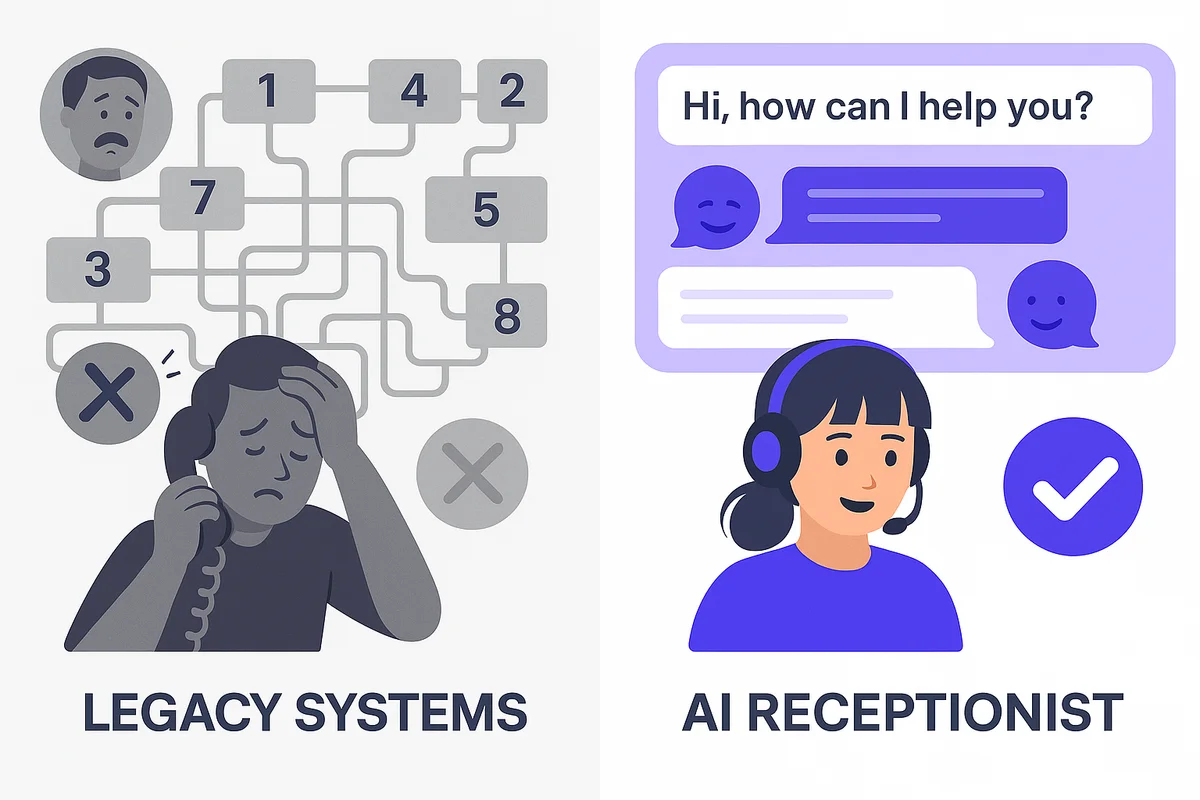
How It Differs from Other Call Solutions
Before choosing any call management solution, it helps to understand how AI phone receptionists compare to the alternatives you may already be using.
Traditional IVR (Press 1 for Sales...)
Interactive Voice Response systems use pre-recorded menus and keypad navigation.
Pros
- Very low cost
- Reliable and simple
- Works for high-volume call routing
Cons
- Rigid and frustrating for callers
- Cannot answer questions
- No natural conversation
- Callers often hang up
Best for: Large enterprises with high call volumes and simple routing needs
Voicemail
The caller leaves a message; you call them back later.
Pros
- Free with most phone systems
- Familiar to callers
- No setup required
Cons
- Misses the sale if competitors answer first
- Delays customer service
- Many callers hang up without leaving messages
- No real-time assistance
Best for: Businesses with low call volume where delayed response is acceptable. For a modern voicemail replacement, see our AI voicemail assistant.
Human Receptionist
A person answers your phone and handles callers directly.
Pros
- Personal touch
- Can handle complex situations
- Builds relationships
Cons
- Costs $35,000+/year in salary and benefits
- Limited to business hours
- Takes sick days and vacation
- Can only handle one call at a time
Best for: Businesses where high-touch personal service is a differentiator
AI Phone Receptionist
Software that uses AI to have natural phone conversations with callers.
Pros
- 24/7 availability
- Handles multiple simultaneous calls
- Natural conversations
- Costs $14–$500/month
- Learns your business quickly
Cons
- Cannot handle highly emotional or complex situations
- Requires initial setup
- May not suit every caller preference
Best for: Small businesses wanting 24/7 coverage to support solo or over stretched teams
AI Phone Receptionist vs. Human vs. Voicemail
See the real cost and capability difference at a glance.
| AI Phone Receptionist | Human Receptionist | Traditional Voicemail | |
|---|---|---|---|
| Annual Cost | < $1,000/year | $35,000+/year | $0 |
| Availability | 24/7/365 | 40 hours/week | Passive recording |
| Response Time | < 1 second | Varies (hold times) | Hours to days |
| Simultaneous Calls | Unlimited | 1 at a time | 1 recording |
| Capability | Answers, books, qualifies, transfers | Full service (limited hours) | Records messages only |
| Languages | 50+ languages | 1–2 typically | N/A |
Business plans from just $39/month — unlimited calls, custom personality
Features You Won't Find Elsewhere
These exclusive capabilities set AI Receptionist apart from every other AI phone system.
Boss Mode
Call your AI number and say "Boss Mode" for an instant verbal briefing on recent calls — who called, what they wanted, what's urgent. Stay informed without opening an app.
Learn about Boss Mode →MMS Image Analysis
Callers can text photos during a call — a broken furnace, a water leak, a dental X-ray. The AI analyzes the image in real-time and responds intelligently.
See In-Call Image Sharing →Call Transfer Permission
The AI sends you an SMS before transferring any call. You approve or decline from your phone — no unwanted interruptions, no missed important calls.
How Call Screening Works →Sub-second response time — callers hear a reply in under 1 second, faster than any human receptionist.
What an AI Phone Receptionist Actually Does
Traditional Call Handling Limitations
Voicemail forces customers to wait hours or days for responses—competitors answer first. Learn how AI can replace voicemail.
IVR systems frustrate callers with rigid menus and no real conversation.
Human receptionists work limited hours and can only handle one call at a time.
Missed calls during busy times, after hours, or weekends mean lost revenue.
No way to answer common questions instantly—callers hang up and call someone else.
Spam and robocalls waste time and make it harder to reach real customers.
How AI Solves These Problems
AI answers every call instantly, 24/7—nights, weekends, holidays—so customers never wait.
Natural conversations using speech recognition let callers speak freely instead of navigating menus.
Handles unlimited simultaneous calls while answering FAQs, booking appointments, and taking messages.
Automatically routes urgent calls to the right person with context and call transcripts.
Responds to common questions using your knowledge base—hours, pricing, services, directions.
Detects and blocks spam calls automatically so you only see real customer inquiries.
Real Scenarios: Who Uses AI Phone Receptionists?
These systems work well for businesses that receive regular phone calls but can't always answer immediately.
After-Hours Emergencies Go Straight to Voicemail
A basement floods at 2 AM. The customer calls you first because they trust your brand—but voicemail answers. In minutes, they call another plumber whose AI receptionist responds instantly, flags the emergency, and dispatches help. By the time you check your phone in the morning, the job (and revenue) is already gone.
Multiple Calls During Rush Hours Mean Lost Jobs
During Monday rush hours or heavy service days, three or four calls can come in at once. Your techs are on-site, the office is busy, and callers hit busy signals or long rings. Most won't leave a message, they simply move on to the next available plumber. Every unanswered call is a potential job lost.
Generic Answering Services Can't Prioritize Real Emergencies
Traditional or outsourced answering services can't tell a minor faucet drip from a sewage backup. They follow generic scripts, miss urgency signals, and can't escalate severe issues. You start the day sorting through voicemails trying to figure out which jobs were real emergencies—causing delays and lost trust before work even begins.
Quick Comparison
| Option | Best For | Typical Cost | What You Get |
|---|---|---|---|
| Human Receptionist | High-touch service businesses | ~$35K/year + benefits | Personal touch, complex handling, limited hours |
| Traditional IVR | High-volume call routing | Low (often included) | Menu-based routing, no conversation |
| Voicemail Only | Low call volume | Free | Messages, delayed response, some hangups |
| AI Phone Receptionist | SMBs wanting 24/7 coverage | $14–$500/month | 24/7 natural conversations, booking, routing |
| Hybrid (AI + Human) | Enterprise / high-touch | $300+/month | AI first, human backup for complex calls |
How AI Phone Receptionists Setup Works
The setup process is typically straightforward and takes minutes rather than days.
Connect Your Phone
Either forward your existing business line or get a new dedicated number. Most systems work with any phone provider, including VoIP and SIP.
Train the AI
Upload or type your business information—FAQs, services, pricing, hours, and how you want calls handled. The AI learns this instantly.
Calls Are Answered Automatically
When someone calls, the AI greets them, understands what they need, and handles it—answering questions, booking appointments, taking messages, or transferring.
You Review & Follow Up
Check your dashboard or receive notifications for calls that need your attention. All conversations are logged with transcripts.
What to Look for When Choosing One
Common Pitfalls to Avoid
Robotic voice quality that sounds unnatural and drives callers away.
Long setup times requiring weeks of technical configuration and training.
Hidden per-minute charges that make costs unpredictable and expensive.
No integration with your calendar, CRM, or existing phone system.
Can't test with real calls before committing to a long-term contract.
Poor spam filtering that lets robocalls through or blocks real customers.
What to Prioritize Instead
Natural, human-like voice that callers can't distinguish from a real person.
Setup in 10–15 minutes with no technical expertise—just enter your business info and go live.
Transparent flat-rate or tiered pricing so you know exactly what you'll pay each month.
Integrates with Google Calendar, Outlook, popular CRMs, and works with your existing phone number.
Free trial with real calls so you can test call quality, AI accuracy, and customer experience.
Advanced spam detection that blocks robocalls while ensuring real customers always get through.
Frequently Asked Questions
Does an AI phone receptionist sound natural?
Modern AI voice technology is remarkably human-like. Most callers can't tell they're speaking with AI. The best systems use natural pauses, conversational language, and appropriate tone. The best way to judge is to call one yourself.
Learn more: Listen to demo calls
How long does setup typically take?
Most businesses can be live within 10–15 minutes. You enter your business information, customize the greeting, and either forward your existing number or activate a new one. No technical expertise is required.
Learn more: View setup guide
Can I keep my existing phone number?
Yes. You don't need to change your business number. Simply set up call forwarding from your current line to the AI system. Alternatively, you can use a dedicated number the service provides.
What happens if the AI can't answer a question?
Good systems handle this gracefully. The AI will acknowledge it doesn't have that information, take a detailed message, and notify you. Some systems (like ours) can also offer to transfer to a human if one is available.
How much does this typically cost?
Pricing varies widely. Basic plans start around $14–$30/month for light usage. Mid-tier plans for growing businesses run $50–$150/month. Enterprise features typically cost $500+/month. Compare this to $35,000+/year for a human receptionist.
Learn more: See our pricing
Is this the same as a chatbot?
No. Chatbots handle text conversations on websites. AI phone receptionists handle actual phone calls using voice. The underlying technology is similar (natural language processing), but the interaction is fundamentally different—people speak naturally rather than typing.
Can it book appointments directly into my calendar?
Most AI phone receptionist systems integrate with Google Calendar, Outlook, and other scheduling tools. The AI checks your real-time availability and books appointments on the spot—no back-and-forth required.
What about accents or difficult callers?
Modern speech recognition handles most accents well. For callers the AI can't understand, it will politely ask them to repeat or offer to take a message. Quality systems improve over time as they learn from interactions.
Ready to Explore Further?
If an AI phone receptionist sounds like a fit for your business, here are logical next steps:
Cancel anytime • Full feature access